The Seven Hermetic Principles: Useful ideas or just spiritual poetry?
Spiritual traditions often claim to hold secret knowledge about how the universe works. Sometimes those claims turn out to be superstition. Sometimes they are metaphors that help people think about life in a new way.
The Seven Hermetic Principles fall somewhere in the middle.
They are most widely known from the book The Kybalion, written by a mysterious group calling themselves Three Initiates. The book claims to summarize ancient teachings attributed to Hermes Trismegistus, a mythical figure associated with early Hermetic philosophy.
Despite the aura of ancient wisdom, historians generally agree that the seven principles themselves are a modern interpretation, not a direct transmission from antiquity.
That does not necessarily make them useless.
Many philosophical ideas are valuable not because they are scientifically proven laws, but because they offer ways of looking at patterns in life. When approached with curiosity instead of blind belief, the Hermetic principles can be read as a set of reflective tools.
Below is a pragmatic look at each one.
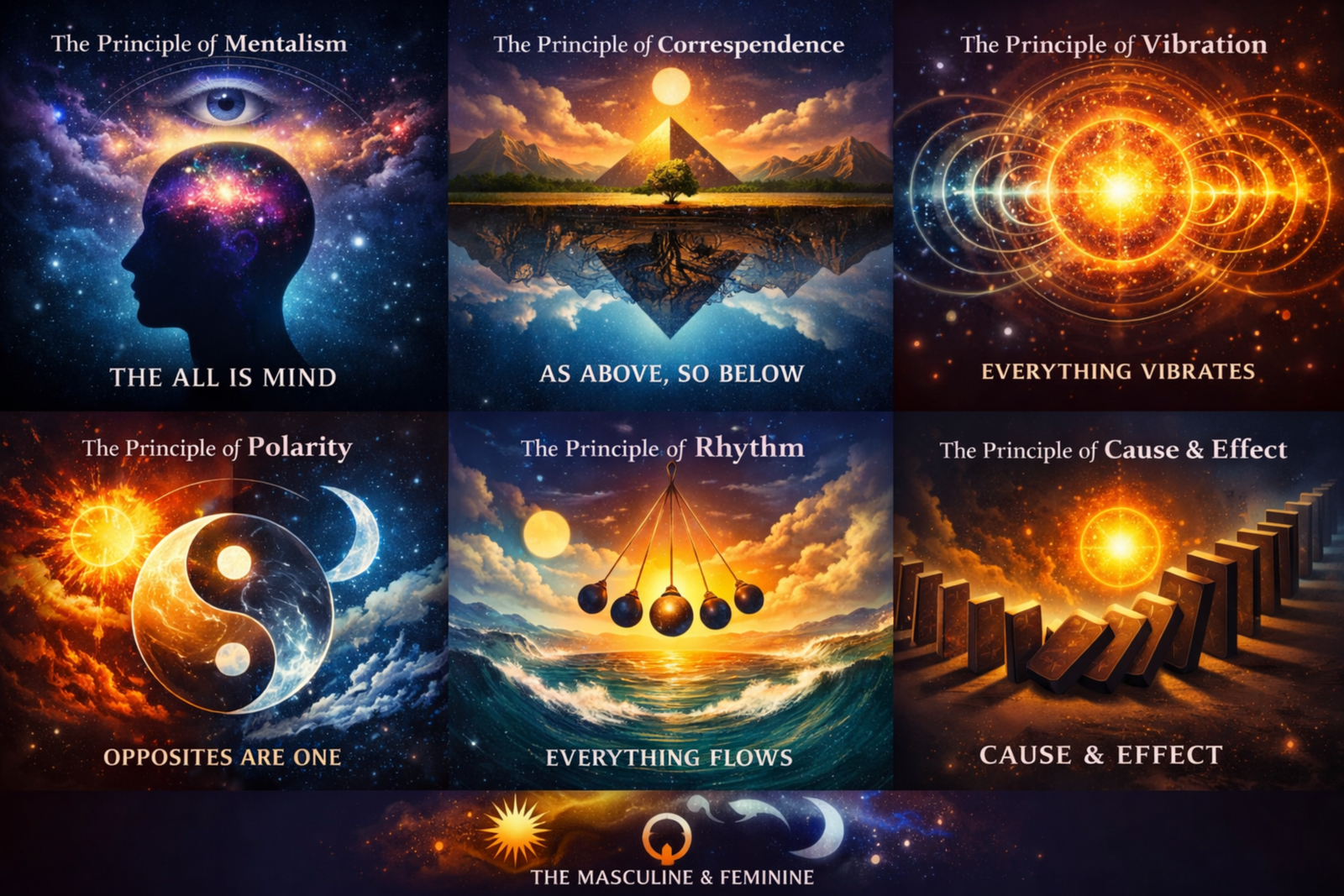
I. The Principle of Mentalism
“The All is Mind; the Universe is Mental.”
Taken literally, this would mean the universe exists inside a cosmic mind. That idea ventures into speculation very quickly.
But interpreted more modestly, the principle highlights something we know to be true. Our experience of reality is filtered through perception, interpretation, and belief. The world we navigate is always partly constructed by our minds.
This principle can be useful if it reminds us that how we interpret events matters as much as the events themselves.
Ii. The Principle of Correspondence
“As above, so below.”
This phrase suggests that patterns repeat at different scales of reality.
Science sometimes finds similar patterns across systems. Fractals, ecosystems, and even social networks often show repeating structures. However, the Hermetic version can easily be stretched too far if people assume every small thing mirrors the entire universe.
A more grounded interpretation might simply be this. Patterns tend to repeat. Learning to notice them can help us understand complex systems.
III. The Principle of Vibration
“Nothing rests; everything moves; everything vibrates.”
Modern physics does show that matter and energy involve constant motion. Atoms vibrate. Waves propagate. Energy flows.
Of course, the Hermetic text was not describing quantum mechanics. Still, the broader idea that change and motion are fundamental features of reality holds up reasonably well.
Where this principle becomes questionable is when people claim thoughts or emotions literally alter reality through mystical vibration. That leap goes beyond evidence.
IV. The Principle of Polarity
“Everything is dual; everything has poles.”
This principle argues that opposites are actually different degrees of the same thing.
Hot and cold are variations of temperature. Loud and quiet are variations of sound intensity. Even emotions sometimes exist along spectrums.
Seen this way, the principle encourages people to think in gradients rather than rigid categories. That mindset can reduce black and white thinking.
V. The Principle of Rhythm
“Everything flows, out and in.”
Life clearly operates in cycles. Day and night. Seasons. Economic booms and recessions. Emotional highs and lows.
The Hermetic idea here is that recognizing cycles can help people ride the wave instead of fighting it. Not every downturn is permanent. Not every peak lasts forever.
VI. The Principle of Cause and Effect
“Every cause has its effect; every effect has its cause.”
This one aligns closely with the basic logic of science. Events occur because something led to them.
The more controversial claim in Hermetic writing is that chance does not exist at all. Most modern thinkers would disagree. Randomness plays a role in many natural processes.
Still, the practical lesson remains valuable. Our choices create consequences, and understanding causes helps us change outcomes.
VII. The Principle of Gender
“Gender is in everything.”
In the Hermetic tradition this does not mean biological gender. It refers to symbolic forces often described as active and receptive, creative and nurturing.
Many traditions use similar metaphors, such as yin and yang in Chinese philosophy.
Whether these forces exist as universal principles is debatable. But the metaphor can still be useful for thinking about balance between action and receptivity in creativity, relationships, and problem solving.
So Are the Hermetic Principles True?
Probably not in the sense of scientific laws.
But they may still be philosophically interesting lenses for observing patterns in life. Like many spiritual ideas, their value depends on how they are used.
If treated as unquestionable truths, they become dogma.
If treated as reflective tools, they can spark curiosity about how systems, patterns, and human perception interact.
And sometimes curiosity is more valuable than certainty.