There is a kind of tired that sleep alone cannot fix.
It is the exhaustion of carrying too much for too long. The fatigue of always being available, always producing, always holding it together. Many women, especially those shaped by caregiving, religion, trauma, or survival, were taught to be useful before they were ever taught to be whole. We learned to keep going, to be dependable, to ignore our limits and call it love, maturity, or faith.
But what if rest is actually holy, and not weakness?
What if choosing to pause, receive, soften, and restore is not a failure of discipline, but an act of spiritual wisdom?
At GRL Society, we believe the Sacred Feminine does not only meet us in power, beauty, and transformation. She also meets us in stillness.
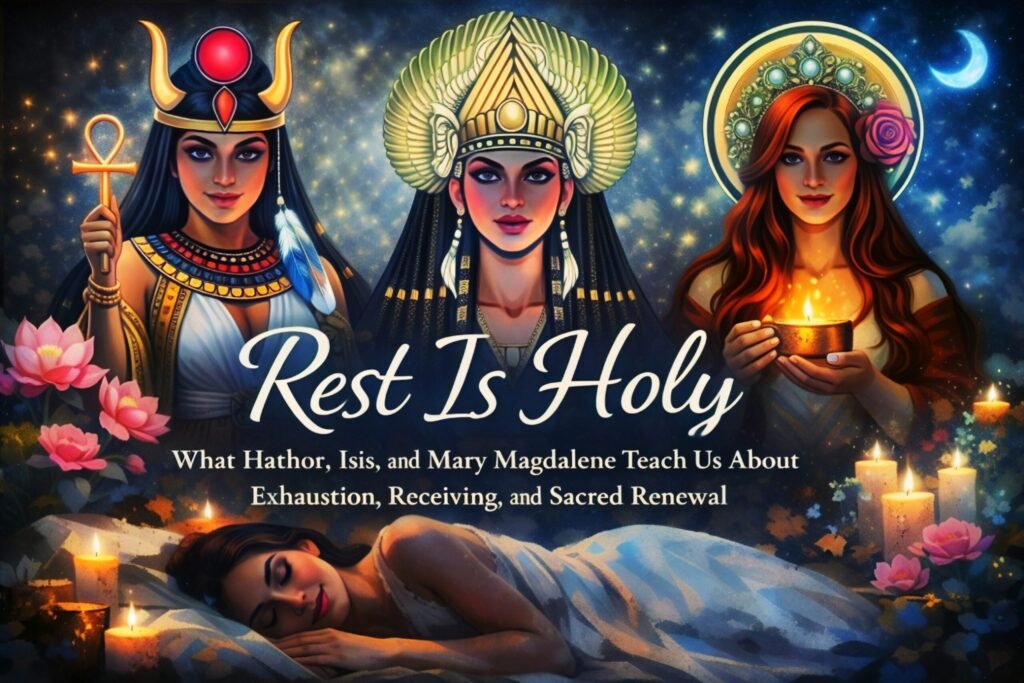
Through the lenses of Hathor, Isis, and Mary Magdalene, we can begin to reclaim rest as sacred renewal.

Hathor: Rest as Pleasure Without Guilt
Hathor reminds us that joy is not a distraction from the sacred. Joy is part of it.
As Goddess of love, music, beauty, sensuality, and celebration, Hathor invites us to remember that the body is not an enemy to overcome. It is a living vessel worthy of delight, tenderness, and care.
For many of us, exhaustion is tangled up with guilt. We feel guilty when we stop. Guilty when we say no. Guilty when we enjoy ourselves while there is still work to do.
Hathor asks, “What if pleasure is part of your healing?”

What if a nap, a bath, a good meal, music in the kitchen, sunlight on your skin, or a quiet moment with no demands is not indulgence, but medicine?
Sacred rest is not only collapse after burnout. It is also the deliberate practice of allowing beauty and ease back into your life before you break. Hathor teaches that replenishment can be sweet. It can be sensory. It can be gentle. It can feel good.
In a world that rewards depletion, choosing pleasure without apology becomes a spiritual act.

Isis: Rest as Restoration and Wise Stewardship of Power
If Hathor teaches us to soften, Isis teaches us to restore.
Isis is the great healer, the sacred magician, the one who gathers what has been scattered and brings life back to what seemed lost. Her energy is not frantic. It is focused. Intentional. Devoted to true repair.
Too often, we treat ourselves like machines. We ask, how much more can I squeeze out of this body, this mind, this heart?
Isis asks a better question: “What is required for restoration?
Rest, through the lens of Isis, is not passive. It is intelligent.
It is recognizing that your life force is precious and not meant to be poured out endlessly with no return. Understanding that power is not proven by constant output. Real power includes conservation. Real wisdom includes recovery. Real devotion includes tending to what is injured, overextended, or neglected.
Isis reminds us that there are seasons when the holiest thing you can do is gather your scattered energy and call it back home.
Not every battle needs to be fought today. Not every request deserves access to you. Not every form of tiredness can be solved by trying harder.
Some things heal in the dark. Some things mend in silence. Some forms of magic only return when you stop forcing and begin listening.


Mary Magdalene: Rest as Receiving, Presence, and Worth Beyond Performance
Mary Magdalene offers a deeply countercultural form of rest.
She represents devotion, presence, intimacy with the sacred, and the kind of spiritual authority that does not come from performance, but from encounter. In a culture that constantly tells us to prove our worth, Mary Magdalene reminds us that we do not earn belonging by exhausting ourselves.
We are allowed to receive.
For many people, rest feels unsafe. If we stop moving, we feel what we have been outrunning. If we stop achieving, we fear we will disappear. If we stop helping, fixing, answering, and producing, we wonder who we are.
Mary Magdalene meets us where we are with compassion.
She teaches that presence is enough. That being with the sacred matters as much as doing for the sacred. That love is not measured only in labor. That tears, stillness, listening, and deep receptivity are not lesser spiritual practices. They are holy ones.
Rest is an act of trust.
It says, I do not have to hold the entire world together by myself.
It says, my value is not dependent on my exhaustion.
It says, I am still worthy when I am quiet.
This kind of rest can feel vulnerable, especially for those who were praised only when they were useful.
Mary Magdalene calls us back to a deeper truth: you are not a machine for meeting other people’s needs. You are a soul. A body. A beloved being. You are allowed to be held too.

Why Rest Feels So Hard
If rest is holy, why is it so difficult?
Because many of us were formed in systems that glorified overextension. We were rewarded for self-abandonment. We were taught to admire endurance more than balance. Some of us learned that love meant never having needs. Some learned that faith meant self-denial without discernment. Some learned that survival required constant vigilance.
So when we try to rest, shame rushes in.
You should be doing more.
You are falling behind.
Other people have it worse.
You are lazy.
You have not earned this yet.
These are not sacred truths. They are inherited pressures.
The Sacred Feminine offers another way. She reminds us that rest is not the opposite of devotion. Rest can be devotion. Rest can be how we return to ourselves, to God, to wisdom, to our bodies, and to the life we are actually meant to live.
Rest as Resistance
Choosing rest in an exhausted culture is not small.
It is a refusal to let productivity become your identity. It is a refusal to let burnout define your normal. It is a refusal to measure holiness by how depleted you are.
Rest says: I belong to myself too.
My body is not an afterthought.
My spirit needs room to breathe.
I do not have to be in crisis to deserve care.
That is not selfishness. That is sacred boundary, sacred stewardship, sacred remembrance.
Practical Practice
Try this simple sacred rest practice this week:
Find one pocket of time, even fifteen minutes, that you will protect from productivity.
During that time: Put your phone down. Step away from chores, work, and demands. Ask yourself, “What would feel genuinely restorative right now?”
Choose one small act of holy rest, such as lying down, drinking tea slowly, sitting in the sun, listening to music, stretching, praying, or doing absolutely nothing.
Then place your hand on your heart and say: “I do not have to earn rest. Rest is holy. Renewal is part of my path.”
Notice what comes up. Relief, discomfort, grief, resistance, longing, all of it is information. Meet it gently.
Restoration begins when we stop treating our own needs like an inconvenience.
Hathor teaches us that rest can be pleasurable.
Isis teaches us that rest can be restorative.
Mary Magdalene teaches us that rest can be receptive and deeply sacred.
Together, they remind us that exhaustion is not a badge of honor. Burnout is not proof of love. Constant strain is not the price of spiritual depth.
You are allowed to pause, to receive, and to return to yourself.
Rest is not a detour from the sacred path. Sometimes, it IS the path.